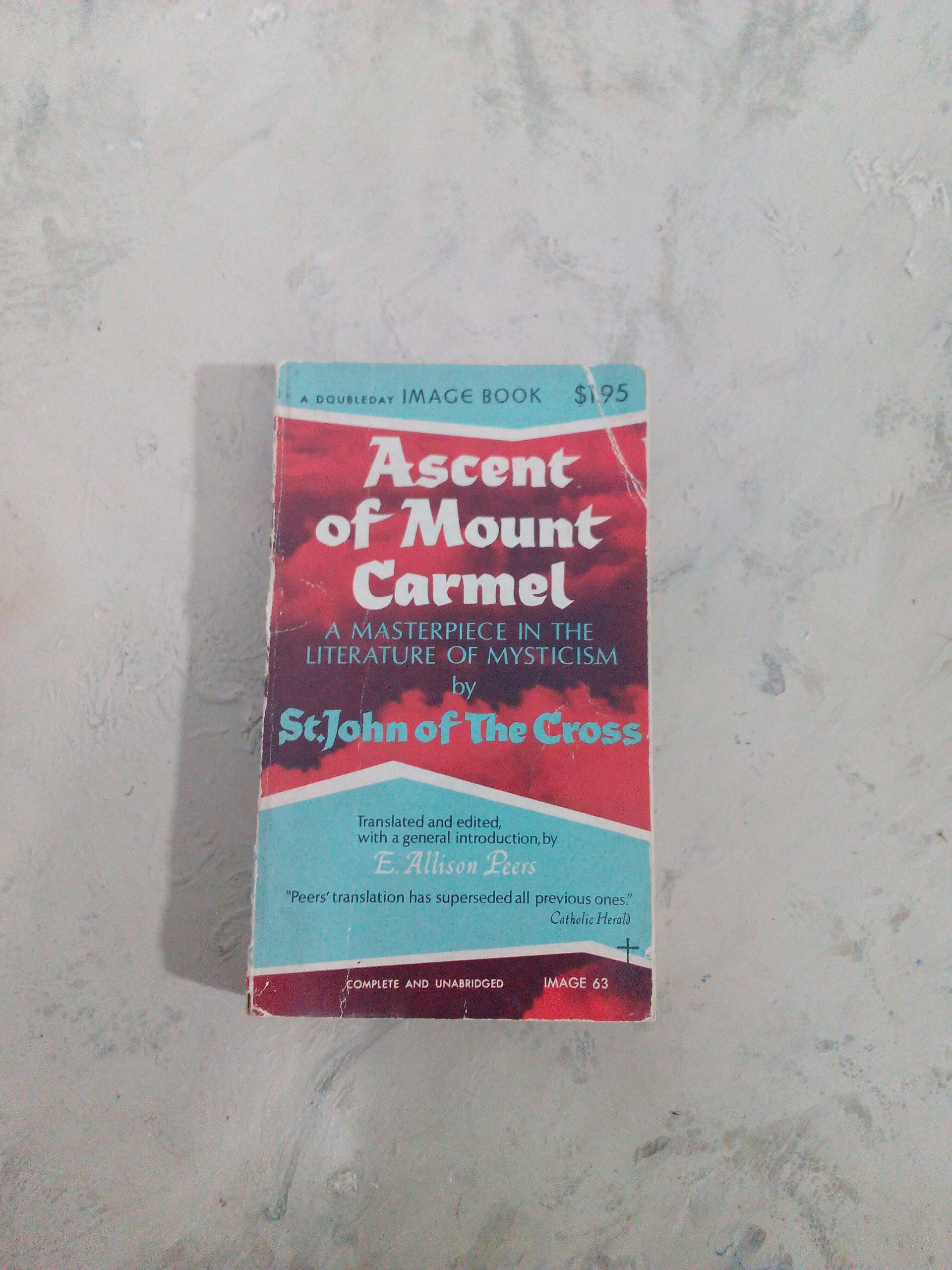

ASCENT OF MOUNT CARMEL BY ST-JOHN THE CROSS
2٬200٬000 تومان
مشخصات کالا
| نوع چاپ کتاب | چاپ اصل |
توضیحات بیشتر
The Ascent of Mount Carmel is one of the most radical texts ever produced within Christian mystical literature because its fundamental movement is not toward the acquisition of something, but toward the systematic elimination of what the subject believes it possesses. Its central operation is subtraction. Knowledge must be relinquished. Sensory satisfaction must be relinquished. Images, representations, consolations, desires, memories, expectations, intellectual securities, and even extraordinary spiritual experiences must be subjected to a discipline of detachment. The ascent therefore proceeds paradoxically: the subject advances precisely by becoming less capable of possessing the object toward which it advances.
This makes the book considerably more philosophically interesting than its conventional classification as a work of Catholic mysticism suggests.
Johns problem is not simply that human beings desire the wrong things. His deeper problem is that desire itself constructs relations of possession. The subject approaches reality through appetite: it wants to see, know, feel, understand, experience, retain. Even religious experience can therefore become another form of appropriation. A mystical vision may appear to bring the subject closer to God, yet the subjects attachment to the vision can become an obstacle to God. The spiritual experience becomes an object, the object becomes a possession, and possession recreates the very structure from which mystical transformation requires liberation.
The extraordinary severity of Johns position emerges here. He does not merely distinguish worldly desire from spiritual desire. He interrogates the mechanism of attachment at a much deeper level. The problem is not only what one desires, but the subjects dependence upon desire as a mode of relation to reality.
Consequently, the famous doctrine of the dark night should not be reduced to melancholy, suffering, depression, or a temporary spiritual crisis. It designates a structural process in which familiar coordinates of consciousness cease to function as reliable supports. The subject enters a condition in which sensory evidence, conceptual mastery, emotional reassurance, and even religious certainty no longer provide the ordinary confirmation upon which identity depends.
This is why Johns language of darkness is philosophically powerful. Darkness is not simply the absence of light. It is the breakdown of the subjects habitual system for recognizing, organizing, and possessing what it calls reality.
The book therefore contains an extraordinary theory of epistemic dispossession. What the subject knows can become an impediment to what the subject seeks. The image can conceal the thing it represents. The concept can become a substitute for encounter. Memory can p what must be relinquished. Desire can transform the desired object into an extension of the desiring subject. The mystical path consequently requires an almost ruthless distinction between reality and the subjects representations of reality.
There is an important philosophical tension here. John writes within a metaphysics in which God is the ultimate reality and the final end of human existence. He therefore does not advocate nihilism. His negation has a destination. Yet the path toward that destination passes through a remarkable sequence of refusals: do not possess this do not cling to that do not confuse experience with truth do not mistake representation for reality do not make consolation into God.
This gives the text a peculiar philosophical structure. It is simultaneously an ontology, an epistemology, a theory of desire, an ethics of discipline, and a technology of subject-formation. It asks what happens to a human subject when the ordinary mechaniپیام through which that subject confirms itself are progressively withdrawn.
The importance of The Ascent of Mount Carmel also lies in its refusal to romanticize interiority. Modern readers sometimes approach mystical literature expecting an exaltation of private experience. John offers almost the opposite. Interior experience is itself dangerous territory. Feelings can deceive. Visions can deceive. intellectual constructions can deceive. Spiritual pleasure can deceive. The subject is not liberated simply by turning inward the interior world must itself be subjected to critique.
For a reader formed by philosophy, this makes the work unexpectedly fertile. It can be placed in productive tension with traditions concerned with asceticism, phenomenology, negative theology, psychoanalysis, existentialism, and theories of desire. Its vocabulary is unmistakably sixteenth-century Christian, but the problems it stages are far larger than its historical setting: What does it mean to desire without possessing? Can knowledge become an obstacle to truth? Can an experience of truth itself become an object of attachment? What remains of the subject when its familiar supports are removed? Is freedom the expansion of possible satisfactions-or liberation from the necessity of satisfaction?
The deepest movement of the book is therefore not climbing but unmaking.
The mountain is ascended through descent: into uncertainty, silence, deprivation, darkness, and the suspension of the structures by which the self ordinarily recognizes itself. John of the Cross constructs an extraordinarily demanding paradox: the closer the subject comes to ultimate reality, the less it can rely upon the forms through which it ordinarily claims to know reality.
That is why The Ascent of Mount Carmel deserves to be read as a major work of intellectual history rather than merely as a religious classic. Its theological conclusions belong to a specific Christian metaphysics, but its investigation of desire, attachment, knowledge, negation, representation, and the dissolution of habitual subjectivity reaches far beyond devotional reading.
This is a difficult book because it attacks the reader at the point where reading itself becomes possession. It does not merely give the reader another system of ideas. It asks what must happen when the desire to possess ideas, experiences, meanings, and even certainty becomes part of the problem.
For the experienced philosophical reader, that is where the real severity of St. John of the Cross begins.

