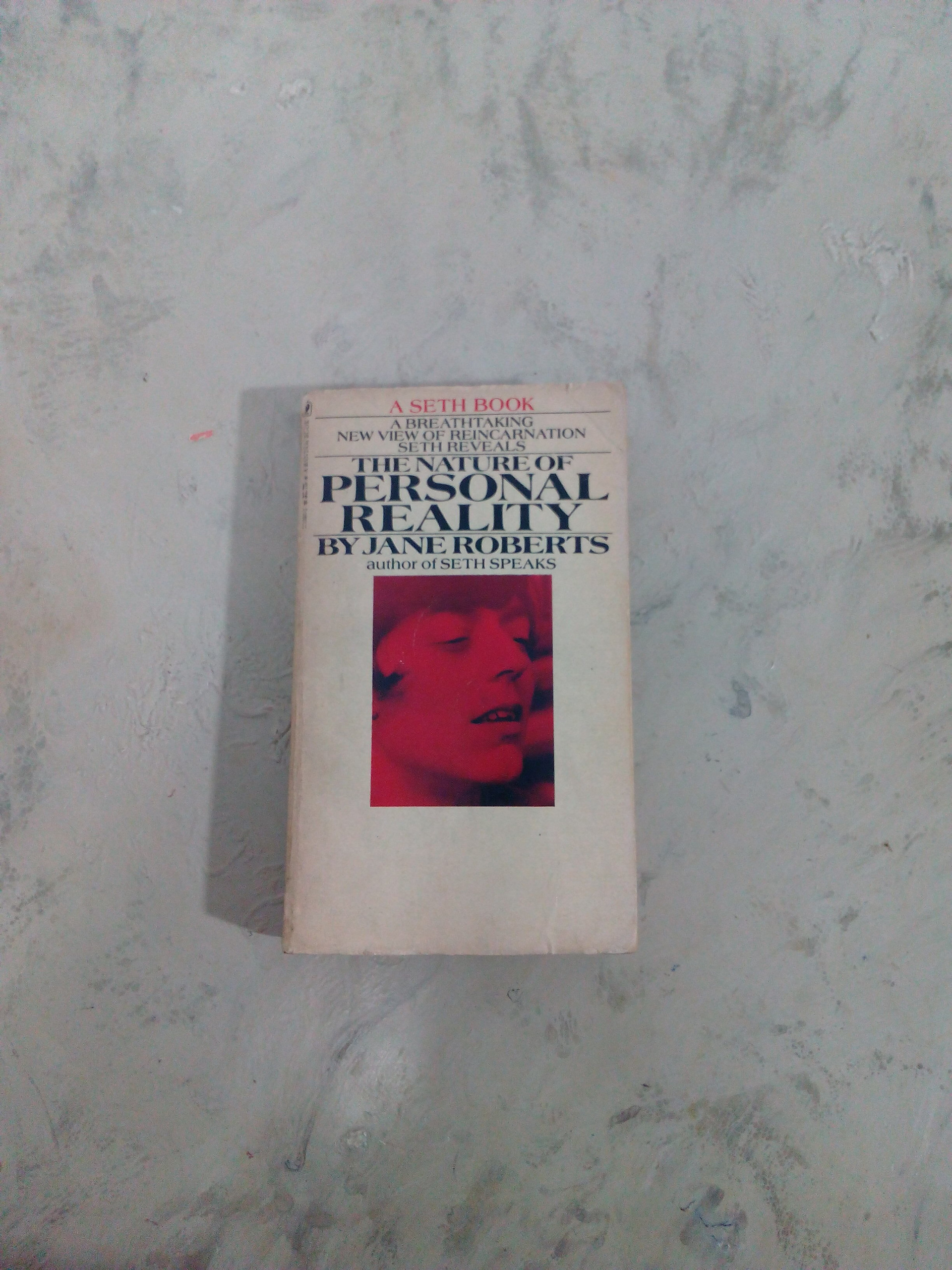




THE NATURE OF PERSONAL REALITY BY JANE ROBERTS
800٬000 تومان
مشخصات کالا
| نوع چاپ کتاب | چاپ اصل |
توضیحات بیشتر
Jane Robertss The Nature of Personal Reality occupies an unusual and historically revealing position within twentieth-century American metaphysical writing. First published in 1974 as part of the corpus of texts attributed to Seth, the book develops an elaborate account of consciousness in which the apparently external world cannot be adequately separated from the interpretive, affective, and intentional structures of the individual. Its subject is therefore not positive thinking in the banal contemporary sense, but the far more difficult problem of how a reality experienced as objective is constituted through systems of belief, expectation, memory, emotion, and self-definition.
The fundamental proposition is radical: personal experience is not simply a passive registration of an already constituted world. The individual participates in the organization of experience. Beliefs function not merely as propositions held by the intellect but as generative structures through which perception, interpretation, anticipation, and action are coordinated. Reality, as lived, is consequently inseparable from the conceptual and emotional architecture through which the individual encounters it.
This position gives the book a distinctly epistemological dimension. Roberts repeatedly destabilizes the conventional distinction between the observer and the observed. If an individual approaches the world with a deeply embedded conception of the self, of what one deserves, fears, expects, permits, or considers possible, then apparently objective circumstances are never encountered without mediation. The question consequently shifts from What is happening? to the more difficult question: What structures of consciousness determine what counts as happening for a particular individual?
Roberts extends this argument into a broader metaphysics of consciousness. The self is not treated as an isolated psychological ego enclosed within an objectively given universe. Rather, consciousness is presented as multidimensional, creative, and capable of participating in realities that exceed the ordinary boundaries imposed by linear time, physical causation, and conventional notions of identity. The result is a conceptual system in which psychological processes and metaphysical claims continuously overlap.
This is also where the book becomes considerably more demanding and more controversial than conventional psychological literature. Roberts does not confine herself to empirically demonstrable mechaniپیام of cognition. Her argument proceeds toward claims concerning the nature of consciousness, the relationship between mind and physical reality, the organization of events through belief and expectation, and the possibility that ordinary waking consciousness represents only a restricted manifestation of a much larger field of awareness.
The books treatment of fear and limitation is particularly significant. Fear is not merely an emotional response to an external threat it can become an organizing principle through which an individual continuously reproduces a particular interpretation of existence. The same applies to guilt, resentment, dependency, and habitual self-conceptions. Robertss concern is therefore not simply that negative beliefs make people unhappy. Her more consequential proposition is that recurrent beliefs establish patterns of experience and thereby acquire the appearance of external inevitability.
In this respect, The Nature of Personal Reality belongs to a much older philosophical problem: the relationship between representation and reality. Yet Roberts approaches the problem through the vocabulary of consciousness and personal experience rather than through classical epistemology. Her work can consequently be read alongside the broader twentieth-century interrogation of the constructed nature of experience, although it does not belong straightforwardly to any academic philosophical school.
Its distance from academic philosophy and empirical psychology is important. The book should not be read as a scientific account of cognition, nor should its metaphysical propositions be retroactively presented as established psychological facts. Its intellectual importance lies instead in the architecture of the system it proposes: a model in which consciousness, belief, perception, identity, and experienced reality form an interconnected process rather than a sequence of independent phenomena.
There is also a persistent tension concerning personal responsibility. If individuals participate in constructing their experienced reality, to what extent are they responsible for what happens to them? Robertss position opens a difficult conceptual territory between agency and circumstance. Read superficially, the argument can be reduced to the familiar doctrine that people create their own lives. Read more carefully, however, it raises a much more complicated question concerning the limits of agency, the unconscious organization of belief, and the extent to which an individual can recognize the structures through which experience is being produced.
This tension is one of the reasons the book remains substantially more interesting than its reputation as a New Age classic might suggest. Its vocabulary may be unfamiliar to readers trained in analytic or empirical traditions, and some of its metaphysical assertions will inevitably remain speculative. Nevertheless, beneath those assertions lies a sustained investigation into a problem that remains philosophically serious: whether the reality of personal experience can ever be separated from the structures of consciousness through which that experience becomes intelligible.
For the advanced reader, The Nature of Personal Reality is therefore best approached neither as conventional self-help nor as a straightforward statement of scientific psychology. It is a substantial document of American metaphysical thought, an ambitious theory of consciousness, and an extended attempt to dissolve the conventional boundary between inner and outer reality.
Its real subject is the instability of that boundary-and the possibility that what we ordinarily call personal reality is not simply the world as it exists, but the world as consciousness has organized it into experience.

