

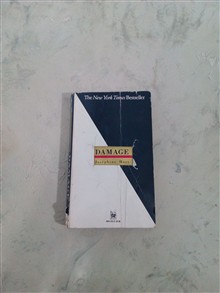
DAMAGE JOSEPHINE HART
550٬000 تومان
مشخصات کالا
| نوع چاپ کتاب | چاپ اصل |
توضیحات بیشتر
Josephine Harts Damage is not merely a novel about an affair, scandal, or forbidden passion. It is a psychological excavation into the hidden territories of human desire, the places where identity, morality, social status, and instinct collide. Published in 1991, the novel remains one of the most unsettling examinations of obsession in modern literature because it does not present destruction as something that comes from outside. Instead, it reveals how the deepest forms of collapse can emerge from within a person who appears completely controlled, successful, and respectable.
At the center of the story is a powerful man who has built an apparently perfect existence: a respected career, a stable family, and a carefully constructed public image. Yet beneath this surface of discipline exists another self ,a hidden landscape of desire, vulnerability, and unresolved impulses. His encounter with Anna Barton does not simply create a new passion it awakens a force that had been concealed beneath years of social order.
The brilliance of Harts novel lies in the way it refuses easy moral explanations. Damage is not a simple story of temptation and punishment. It is a deeper investigation into the fragile architecture of the human personality. The question is not only why a person destroys everything they have built, but also whether the foundations of that life were ever as secure as they appeared.
Through a cold and precise style, Hart explores the distance between the person we present to society and the person that exists beneath that performance. The novel enters a psychological territory where desire is not romanticized as freedom, nor condemned as simple weakness. Instead, desire becomes a powerful force capable of revealing hidden truths about the self.
The narrators obsession with Anna is disturbing because it gradually moves beyond ordinary attraction. She becomes a symbol of escape, intensity, and a confrontation with everything he has denied. The object of desire becomes less important than the transformation it produces inside the individual. In this sense, Damage becomes a study of obsession itself: how the mind can create its own prison while believing it has discovered liberation.
For readers interested in Freud, Nietzsche, existential psychology, or the darker dimensions of human nature, Harts novel offers a remarkable field of interpretation. Freuds concept of repression appears throughout the story: what is suppressed does not disappear it returns in unexpected and sometimes destructive forms. Nietzsches examination of morality and instinct also echoes through the novel, questioning whether civilized identity is truly stable or merely a carefully maintained surface. From a modern psychological perspective, Damage explores the conflict between social identity and unconscious desire.
What makes the novel powerful is not the extraordinary nature of its events, but their terrifying human possibility. Hart does not create a world of monsters. She creates a world of ordinary human beings whose inner contradictions can become catastrophic. The true horror of the book is recognizing that destruction does not always announce itself through violence or madness sometimes it arrives through a moment of desire, a private decision, or an unexplored weakness.
Damage belongs to the tradition of literature that examines the collapse of certainty. It asks uncomfortable questions about love, obsession, morality, self-deception, and the limits of personal control. Rather than offering simple answers, it opens a psychological territory where readers confront the unstable relationship between reason and impulse.
This is a novel for those who are interested not only in what people do, but in the hidden mechaniپیام that make them capable of doing it. Josephine Hart transforms a personal tragedy into a wider investigation of the human condition, a study of how the deepest damage often begins in the places we believe are most securely protected.

